
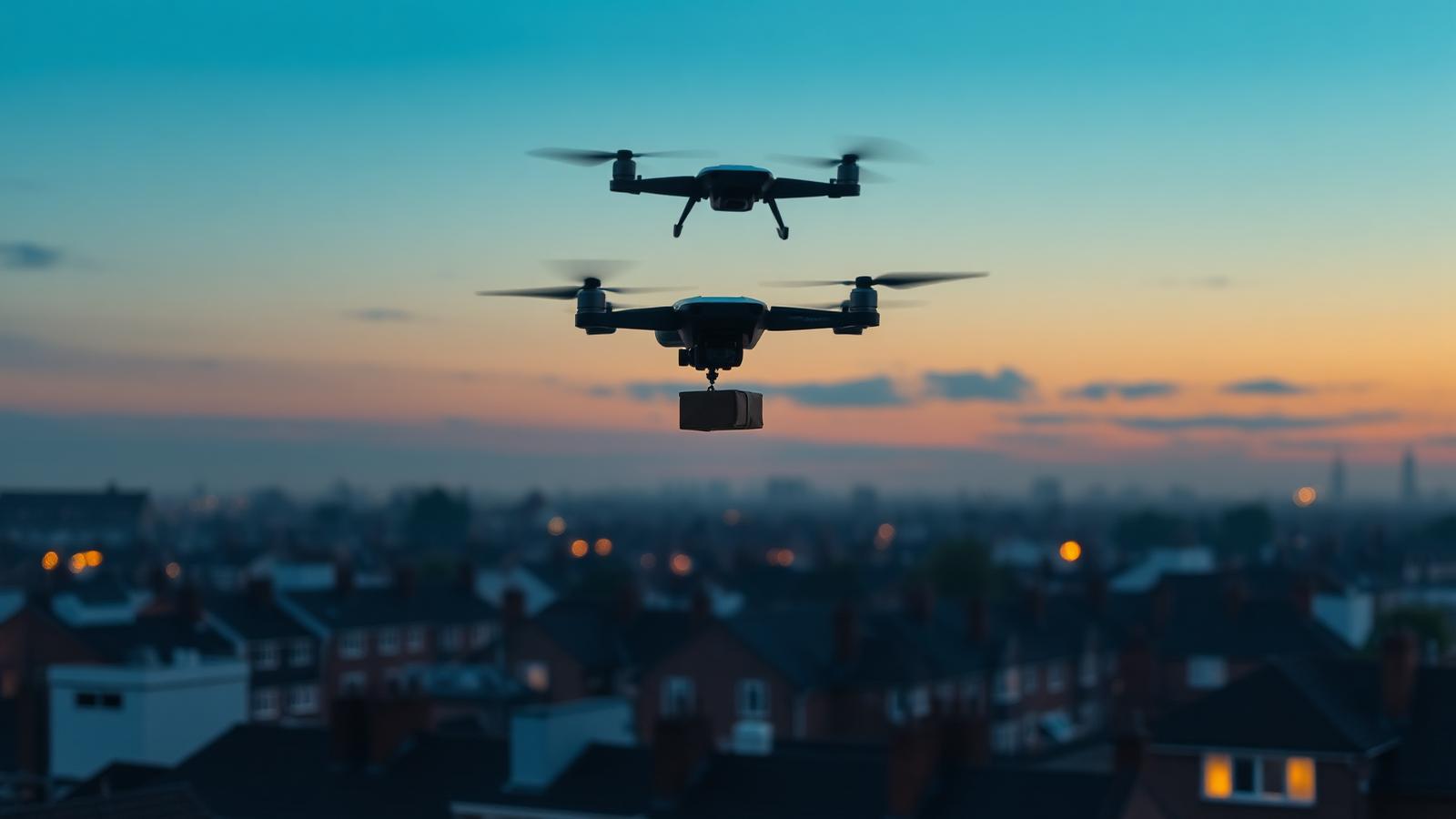
For decades, the idea of a drone delivering a parcel to a British home sounded like science fiction. Now it is moving steadily into the realm of aviation policy, commercial trials and regulation.
The crucial change is not simply that drones are becoming more capable. It is that the UK's aviation system is beginning to prepare for a future in which thousands and potentially millions of unmanned aircraft can operate beyond the direct sight of a human pilot.
The UK Civil Aviation Authority (CAA) has now set out a roadmap towards routine Beyond Visual Line of Sight (BVLOS) operations by 2027. That is the regulatory milestone that could eventually make large scale drone deliveries practical.
Table of contents
The big breakthrough: drones no longer need to be seen by their pilot
Today, many ordinary drone operations are constrained by a basic rule: the remote pilot must be able to see the aircraft. That is workable for photography, surveying and short range work. It is not workable for a delivery company sending a drone from a fulfilment centre across an entire city.
The future of commercial delivery therefore depends on BVLOS, flying Beyond Visual Line of Sight. The CAA's plan is to move away from advanced drone operations being routinely confined to specially segregated areas, and towards greater integration with the wider airspace system.
In practical terms, a delivery company could eventually operate a fleet of drones from a control centre, with pilots supervising multiple aircraft rather than manually flying one drone at a time.
The first drone deliveries may not be Amazon-style parcels
The most compelling early uses may be medical and emergency deliveries rather than ordinary shopping. The CAA has highlighted possible operations including specialist chemotherapy drugs to hospitals, mail to remote locations and defibrillators for emergencies.
The economics are strongest when speed and access matter more than parcel value. A drone carrying a £20 online order can't easily beat a van doing dozens of stops. A drone getting a defibrillator across gridlocked roads in minutes clearly can.
How the market is likely to develop
- 1Medical & emergency logisticsChemotherapy drugs, blood, defibrillators where minutes matter
- 2Infrastructure inspectionsEnergy grids, pipelines, rail on repeatable BVLOS routes
- 3Remote and hard to reach deliveriesIslands, farms, offshore assets
- 4Distribution centre shuttlingScheduled runs between logistics hubs
- 5Routine deliveries to homesThe final stage and the furthest away
Will drones really fly above every UK city?
Eventually, potentially, but not necessarily in the way people imagine. The phrase "air corridors above houses" suggests fixed lanes in the sky. Some future operations could indeed use defined routes or corridors, particularly where traffic is high. But the CAA's broader vision is integration, not a permanent separate motorway system above every street.
The likely future is a mixture of the following:
- Designated routes for high volume drone traffic
- Dynamic geofenced areas
- Approved flight paths
- Automated traffic management systems
- Aircraft that safely adapt their routes around other airspace users
A drone might travel along a planned route for most of its journey before making a controlled final approach to a delivery location. The airspace above urban Britain is likely to become increasingly managed, digitally monitored and shared.
A new "electronic identity" for drones
One of the most important changes already taking place is Remote ID. From 1 January 2026, certain classes of UK drone must use Direct Remote ID. The system broadcasts information allowing authorised authorities and nearby receivers to identify an aircraft in flight.
Remote ID can broadcast:
- Operator identification
- Aircraft's unique serial number
- Position and height
- Course
- Remote pilot's location
- Certain emergency information
New rules already came into force in 2026
The UK's drone regulations have already undergone important changes. From 1 January 2026, anyone flying a drone weighing 100 grams or more generally needs a Flyer ID, while new UK class marking requirements and Remote ID rules have been introduced in stages.
The revised framework also uses clearer descriptions for the Open Category subcategories:
The CAA is preparing a far more flexible framework
Historically, advanced drone operations often required detailed, individual permissions. That works for trials but becomes cumbersome once hundreds of companies want to run similar services.
The regulator is developing a framework that can support routine BVLOS operations while maintaining safety. Work includes requirements for Detect and Avoid systems, technology that helps aircraft identify and respond to potential conflicts. A full policy publication is planned for 2026.
The CAA has also selected trials covering drone deliveries, medical transport, energy infrastructure and proposed "sky highway" concepts. These trials are effectively testing the building blocks of a future national system.
Making aircraft electronically visible
In July 2026, the CAA launched a consultation on electronic conspicuity, technology that lets aircraft broadcast their position electronically. The proposals could eventually make it mandatory for civil aircraft operating below 10,000 feet, subject to consultation.
The principle is straightforward: if aircraft can reliably broadcast where they are, other aircraft and traffic management systems have a much better chance of detecting conflicts before they become dangerous.
The law itself may need to change again
In May 2026, the Law Commission of England and Wales published recommendations on aviation autonomy, arguing that the existing legal framework needs clarification and targeted reform. A future delivery drone may not simply be "flown" in the traditional sense, a remote pilot might supervise a fleet while automated systems handle navigation, route selection and collision avoidance.
The law will have to answer increasingly difficult questions:
- Who is legally responsible if an autonomous drone makes a mistake?
- What happens if a drone loses its communications link?
- Who is responsible for a collision?
- Can an automated system make an emergency decision?
- How should the system respond if a person deliberately interferes with the aircraft?
The future is closer than people think, but it will arrive gradually
The UK is not about to wake up one morning with delivery drones flying above every house. The more likely scenario is gradual expansion.
First, controlled trials. Then regular operations on specific routes. Then networks connecting hospitals, warehouses, ports, industrial sites and remote communities. As technology, regulation and public acceptance improve, delivery zones could expand into more urban areas.
The biggest transformation may be almost invisible from the ground. Instead of every delivery drone flying wherever it wants, future systems could resemble an invisible digital road network, aircraft with electronic identities, approved routes, automated traffic coordination and remote supervision.
What a future delivery drone actually needs
Scalable drone delivery depends on several systems working together, not on the aircraft alone.
Approved operating framework
Repeatable regulatory pathway for scalable BVLOS operations, not a series of individual exemptions.
Identifiable electronic identity
Remote ID so authorised bodies can identify aircraft in flight.
Reliable communications
Command, control and traffic management links that don't drop out over urban terrain.
Detect and Avoid
Technology and procedures that let a drone find and separate from other airspace users.
Electronic conspicuity
Aircraft broadcasting their position so drones, helicopters and light aircraft can see each other.
Qualified operators
Appropriately authorised organisations and pilots, not a free for all above the rooftops.
Useful CAA resources and further reading
Official Civil Aviation Authority pages covering the regulatory changes and technologies shaping UK drone delivery.
The main BVLOS programme page and roadmap to 2027.
How operators obtain BVLOS authorisation in the Specific Category.
Phased Remote ID legal requirements, including 2026 changes.
How Remote ID links to registration and traceability.
Technology and standards to reduce mid air collision risk during BVLOS.
The wider regulatory package, including UK class marking and new 2026 rules.
The regulator's latest changes and announcements.
Remote ID, UAS review, class marking, Detect and Avoid, SORA, BVLOS.
Related reading
This article provides general information and does not constitute legal or regulatory advice. UK drone regulations continue to evolve, so always check the CAA's latest guidance and the specific requirements applying to your operation.